

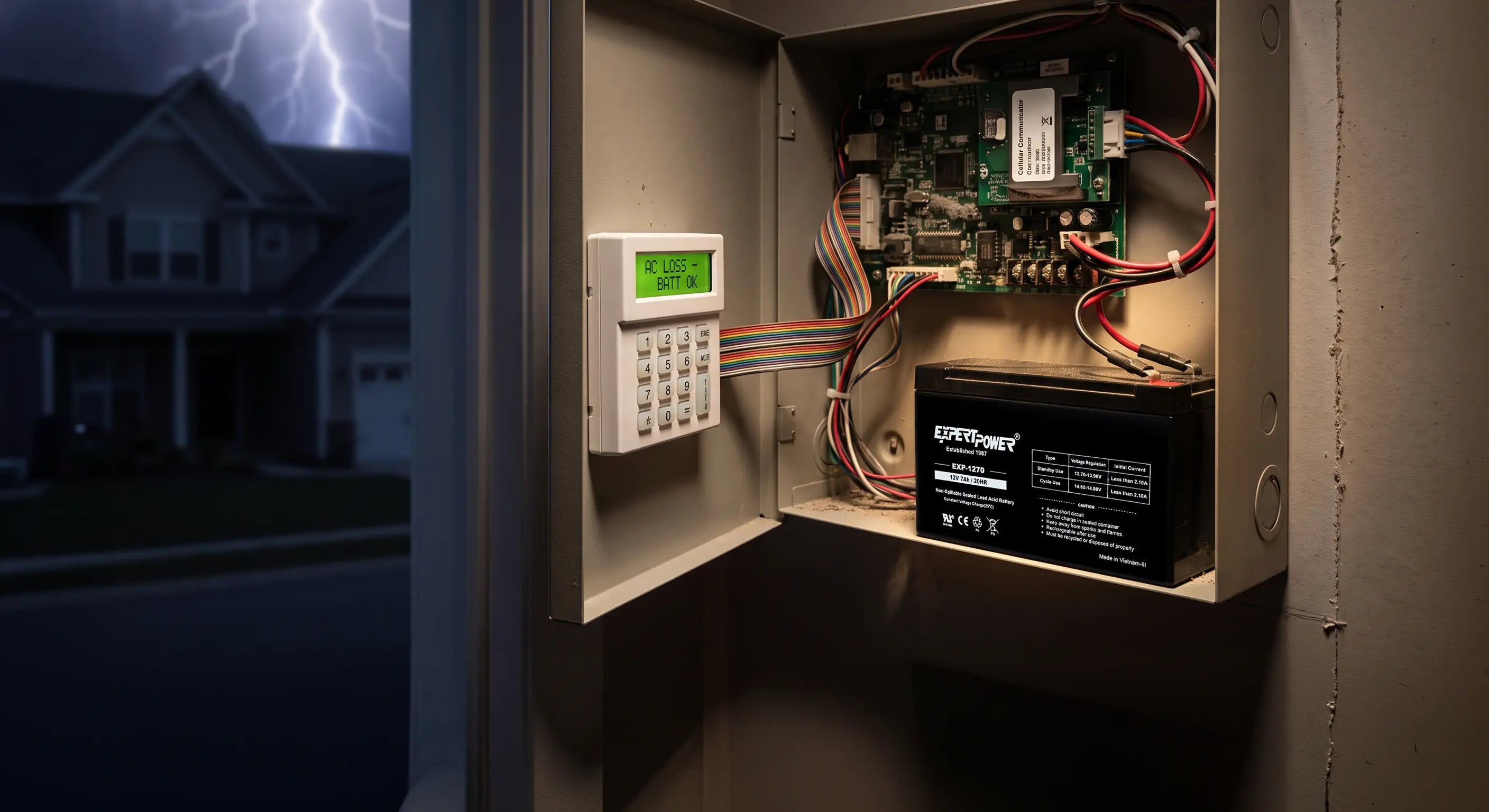


Severe storms, sudden grid spikes, or unexpected utility work can knock out neighborhood power in an instant. For most property owners, the blackout brings dark rooms, quiet appliances, and—within minutes—an annoying, persistent trouble beep from the alarm keypad.
When the grid goes dark, your property’s physical security shouldn’t go down with it. Blackouts are when properties are often at their most vulnerable.
Fortunately, intrusion alarms and fire panels don’t rely solely on wall electricity. Hidden inside that locked metal cabinet on the wall is a dedicated 12-volt backup battery designed to keep your sensors running. But how long can you actually expect that battery to last, what happens while it’s running, and is your current battery up to the task?
What Actually Happens to Your Alarm System When Power Drops?
Modern security systems are engineered with automatic failover. Under normal conditions, your system runs on standard household alternating current (AC) power supplied by a plug-in wall transformer, while simultaneously keeping the internal backup battery topped off.
The moment wall power is lost:
- Instant Transition: The panel smoothly transfers the entire system over to the internal 12V battery with zero interruption. Your sensors never turn off, and your perimeter stays armed.
- Keypad Alert: Most keypads chime or display an "AC Loss" or "No AC" indicator to let you know the system is now running on battery reserves.
- Core Sensors Stay Live: Hardwired door and window contacts, glass-break sensors, and passive motion detectors continue drawing standby power directly from the battery.
- Emergency Signals Still Transmit: If you have a modern cellular communicator installed, it uses the battery reserve to communicate arm/disarm events and alarms back to the monitoring station, even if internet routers and landlines are completely dead.
What Drains the Battery Faster?
Not every outage draws power at the same rate. Your backup battery will drain significantly faster if:
- An alarm is triggered: Loud external sirens and strobe lights pull massive amounts of power compared to quiet standby monitoring.
- Cellular signals are weak: During bad storms, cell towers can experience interference. Just like a smartphone battery drains quickly in low-service areas, an alarm’s cellular radio burns extra power attempting to stay connected to distant towers.
- Bright displays stay on: Large, backlit touchscreen keypads naturally consume more power than traditional numeric push-button panels.
Battery Sizing Made Simple: Rules of Thumb
Instead of digging into complicated electrical formulas and load calculations, you can gauge your runtime expectations with a few simple rules of thumb based on your battery’s amp-hour (Ah) rating.
1. Small Residential Setups (12V 4Ah to 5Ah)
- Best For: Apartments, condominiums, or smaller homes with just a few door contacts and a single standard keypad.
- Outage Expectation: Designed primarily for short blips and overnight outages. Under normal conditions, expect roughly 8 to 14 hours of standby runtime.
- Explore Options: Browse 12V 4Ah to 5Ah alarm battery replacements.
2. Standard Homes & Small Offices (12V 7Ah to 9Ah)
- Best For: Typical single-family homes, multi-story residences, and small commercial storefronts. These systems usually power multiple keypads, several motion sensors, and an LTE cellular module.
- Outage Expectation: Built to provide a solid full 24 hours of dependable standby coverage through typical day-long outages.
- Explore Options: View compatible 12V 7Ah to 9Ah backup batteries.
3. Commercial Facilities & Fire Systems (12V 12Ah+ or Dual Batteries)
- Best For: Larger facilities, warehouses, multi-zone commercial properties, or dedicated commercial fire panels that must comply with strict life-safety standards.
- Outage Expectation: Delivers 24 to 48+ hours of extended standby runtimes to survive long holiday weekends or severe regional storm damage.
- Explore Options: Find high-capacity 12V 12Ah+ and commercial alarm batteries.
Quick Tip — The Cabinet Check: Open your metal alarm panel cabinet and read the label on the existing battery. If you currently have a compact 12V 4.5Ah battery but notice empty space inside the cabinet, you can often physically upgrade to a standard 12V 7Ah or 8Ah battery for substantially longer runtime during an outage.
Lead-Acid vs. LiFePO4: How They Hold Up in a Real Blackout
Historically, virtually every alarm panel has run on a standard Sealed Lead-Acid (SLA) or AGM battery. Today, drop-in Lithium Iron Phosphate (LiFePO4) batteries are rapidly becoming the preferred alternative.
Traditional Sealed Lead-Acid (SLA)
- The Pros: Readily available, inexpensive upfront cost, and reliable for standard day-to-day trickle charging.
- The Outage Vulnerability: Lead-acid chemistry struggles with deep discharges. If an extended storm drains a lead battery down past 50% capacity, its voltage drops sharply, which can cause the panel to shut off prematurely. Worse, if an SLA battery is completely drained flat over a multi-day blackout, internal damage (sulfation) permanently degrades its lifespan—meaning it may never hold a full charge again once power returns.
Lithium Iron Phosphate (LiFePO4)
- The Upgrade: Modern 12V LiFePO4 drop-in replacements share the exact same physical dimensions and terminal connectors as legacy SLA batteries, making replacement seamless.
- The Outage Advantage: LiFePO4 batteries deliver rock-steady voltage from 100% all the way down to nearly empty, keeping your sensors and cellular radios fully operational right up to the end. They can be deeply discharged without damaging the internal cells, recover cleanly once utility power is restored, and last 8 to 10+ years—more than double the lifespan of traditional lead-acid batteries.
| Feature | Standard Sealed Lead-Acid (SLA) | Upgraded Lithium (LiFePO4) |
|---|---|---|
| Initial Cost | Budget-friendly upfront | Slightly higher initial investment |
| Outage Usability | Loses voltage rapidly as it drains | Consistent, flat power output until depleted |
| Deep Drain Recovery | Can permanently damage battery health | Recovers cleanly with built-in protection |
| Typical Lifespan | 3 to 4 years | 8 to 10+ years |
| Maintenance Profile | Regular replacements & trouble beeps | "Set-and-forget" long-term peace of mind |
3-Step Outage Readiness Checklist
- Check the Date Sticker: Sealed lead-acid batteries have an average service life of 3 to 5 years. If your battery’s date code shows it was installed more than 3 or 4 years ago, treat it as living on borrowed time and replace it before a storm tests it for you.
- Inspect the Physical Case: Unplug the battery and inspect the plastic housing. Look for white, chalky corrosion around the terminal tabs or any swelling and bulging on the sides. If the battery is warped or corroded, replace and recycle it immediately.
- Don’t Ignore the Keypad Chime: A panel that beeps every few hours with a "Low Batt" trouble code isn't crying wolf. Silencing the buzzer doesn't fix the battery; it just means the next power flicker could take your entire security system offline.
Stay Protected, Even When the Grid Fails
An alarm system is only as dependable as the reserve battery keeping it alive. Don't wait for the next severe storm or rolling blackout to find out your backup power is depleted.
Whether you need a direct-fit Sealed Lead-Acid replacement for routine maintenance or an ultra-durable LiFePO4 battery for long-term peace of mind, make sure your security system is storm-ready today.