

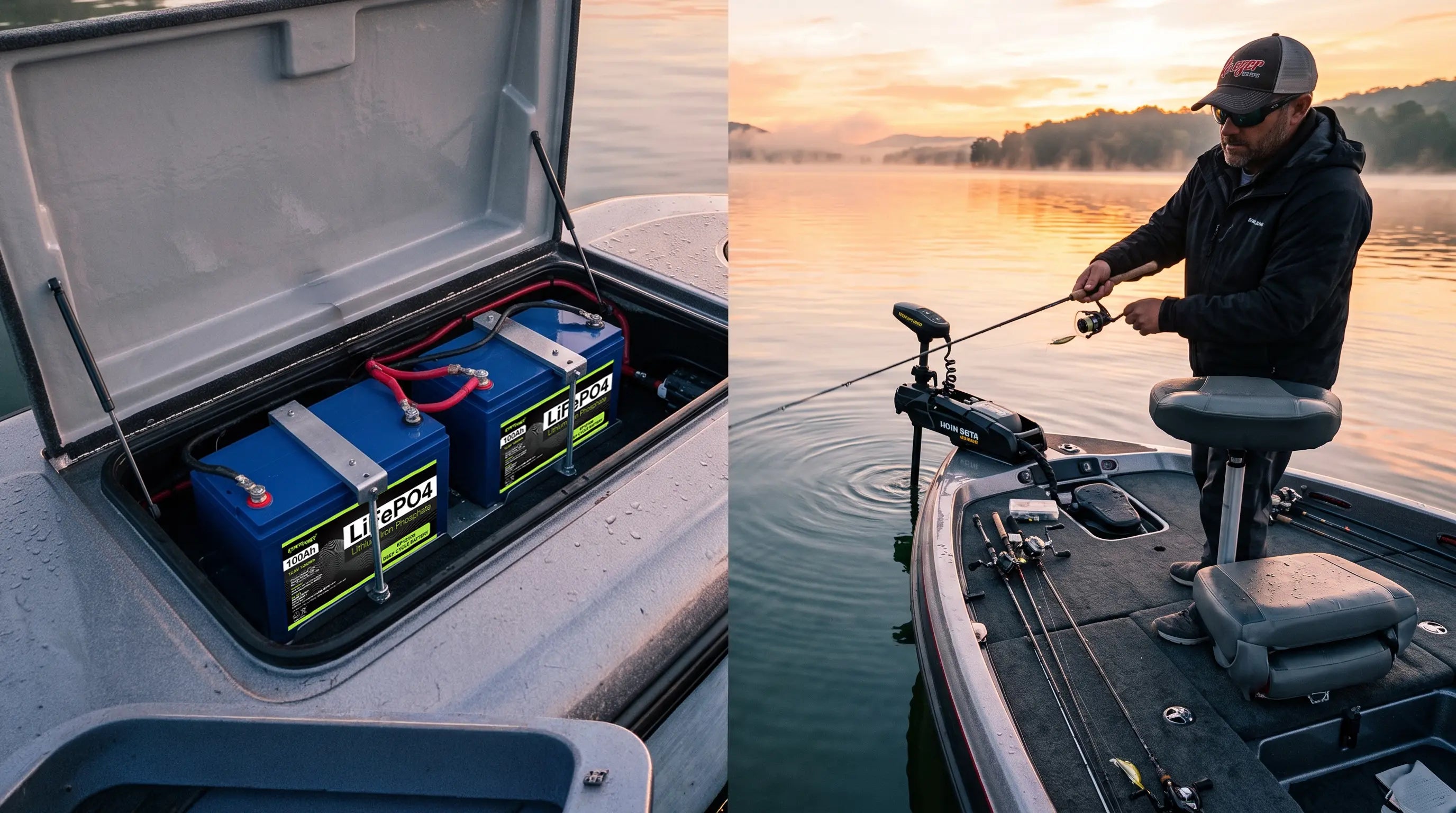


Every seasoned angler knows the mid-afternoon slump. You find the perfect spot, battle an afternoon headwind or chop, set your trolling motor to speed 5, and immediately notice it feels more like speed 3. You check your battery indicator, and it shows 40% capacity remaining, yet your thrust has noticeably dropped.
For decades, heavy deep-cycle lead-acid and AGM batteries were simply the cost of doing business on the water. Today, the marine industry is rapidly transitioning to LiFePO4 Lithium Marine Batteries. Upgrading your trolling motor bank to lithium is not just about shedding pounds; it fundamentally transforms how your boat handles, tracks, and performs from dawn until dusk.
1. The Voltage Sag Problem vs. The Flat Discharge Curve
The single biggest functional difference between traditional marine chemistries and LiFePO4 lies in the discharge curve under load.
Lead-acid batteries suffer from continuous, steep voltage sag. A fully charged 12V lead bank sits around 12.7V, but as you draw power throughout the morning, the working voltage quickly declines to 12.2V, 11.8V, and lower. Because electric trolling motor thrust is directly proportional to operating voltage, lower voltage means weaker prop RPM and diminished peak thrust—even if half the battery capacity is still untouched.
LiFePO4 batteries deliver an exceptionally flat discharge curve. A lithium cell holds a firm ~13.2V to 12.8V under continuous load across virtually its entire capacity. Whether your bank is at 95% or 5% State of Charge (SoC), your trolling motor receives clean, consistent voltage. A setting of speed 5 delivers the exact same propulsion at 4:00 PM as it did when you launched at 6:00 AM.
2. Weight Reduction and Hydrodynamic Gains
Weight is the mortal enemy of small boat performance. A standard 24V or 36V trolling system using two to three Group 27 or 31 lead-acid batteries forces your hull to carry between 130 to 200+ lbs of deadweight, typically concentrated in the bow or the aft battery compartment.
By swapping to lightweight lithium alternatives, you eliminate approximately 70% of that ballast. A 12V 100Ah LiFePO4 battery weighs around 25 lbs compared to a comparable 65-lb lead-acid unit.
- Faster Hole Shots & Top Speed: Reduced stern squat allows your boat to plane faster with less engine strain, saving fuel on your primary outboard.
- Drafting in Shallow Water: Shedding 100+ lbs lowers your overall displacement, reducing your draft by crucial inches in skinny flats, marshes, and shallow coves.
- Responsive Spot-Lock: Digital GPS anchors and bow-mount trolling motors work significantly less to hold position when they aren’t fighting heavy bow inertia against wind and current.
3. Usable Capacity: 100Ah vs. 100Ah Isn’t Equal
Battery capacity labels can be misleading if you do not factor in Peukert’s Law and depth-of-discharge thresholds.
A standard 100Ah lead-acid battery only provides roughly 50Ah of usable power. Discharging below 50% causes severe sulfation, permanently degrading cell health and rapidly truncating service life. Furthermore, heavy continuous draws (like churning against strong tidal currents) trigger Peukert’s Law, artificially shrinking the total capacity available during high-amp use.
LiFePO4 provides 100% of its rated capacity safely without structural damage. A single 100Ah lithium battery delivers the effective run-time of two 100Ah lead-acid batteries wired together, with zero capacity penalty under sustained high-amp trolling draw.
4. Marine Rigging & Installation Checklist
Upgrading your craft to lithium is straightforward, but marine safety standards require addressing three essential points:
- Dedicated Lithium Charging Profile: Do not use standard lead-acid multi-stage chargers. Traditional chargers rely on aggressive equalization stages or desulfation pulses that exceed safe voltage ceilings. Always pair your bank with an on-board charger featuring a dedicated LiFePO4 algorithm (constant current / constant voltage stopping cleanly around 14.4V–14.6V per 12V block).
- Circuit Breaker Sizing: Brushless and high-thrust trolling motors can pull brief, high current spikes. Ensure your positive lead includes an ABYC-compliant, marine-grade circuit breaker (typically 50A or 60A depending on motor specs) to protect wiring and prevent nuisance trips on your internal Integrated Battery Management system.
- Keep the Cranking Battery Isolated: Unless your lithium unit is specifically designated as a dual-purpose or starting battery with high Cold Cranking Amps (CCA), keep your trolling motor lithium bank on its own isolated circuit, using an AGM or starting battery connected to your outboard's alternator.
Long-Term Economics on the Water
While the initial cost of LiFePO4 is higher than flooded lead-acid, the long-term economics strongly favor lithium. A typical tournament angler or frequent boater replaces lead-acid trolling banks every 2 to 3 years due to capacity decay. With a cycle life exceeding 3,000–5,000 deep cycles, a quality LiFePO4 marine bank routinely lasts 10 years without maintenance, water top-offs, or terminal corrosion.
Lighter weight, constant full-day thrust, zero maintenance, and unmatched longevity make lithium the definitive power platform for modern marine craft.
Ready to Upgrade Your Time on the Water?
Don't let voltage sag and heavy ballast cut your fishing trips short. Experience full-throttle thrust from launch to loading dock with reliable, lightweight marine power.
Explore ExpertPower LiFePO4 Batteries