



Level Up Your Flight Experience
You’ve done the unboxing. You’ve mastered the hover. You’ve even stocked up on a couple of extra batteries to keep the fun going. But now that you are getting comfortable behind the sticks, you might be asking: Now what?
While the drone itself is a marvel of engineering, the difference between a casual flyer and a cinematic pro often comes down to the kit they carry. The right accessories don’t just make flying more fun; they make your flights safer, your footage smoother, and your workflow professional.
In this guide, we are highlighting the "unsung heroes" of the drone world—the tools that solve common headaches like lens glare, rough landings, and dreaded "card error" messages.
Vision and Clarity (Filters)
If you want your footage to look like a movie rather than a soap opera, you need to manage light. This is where lens filters come in.
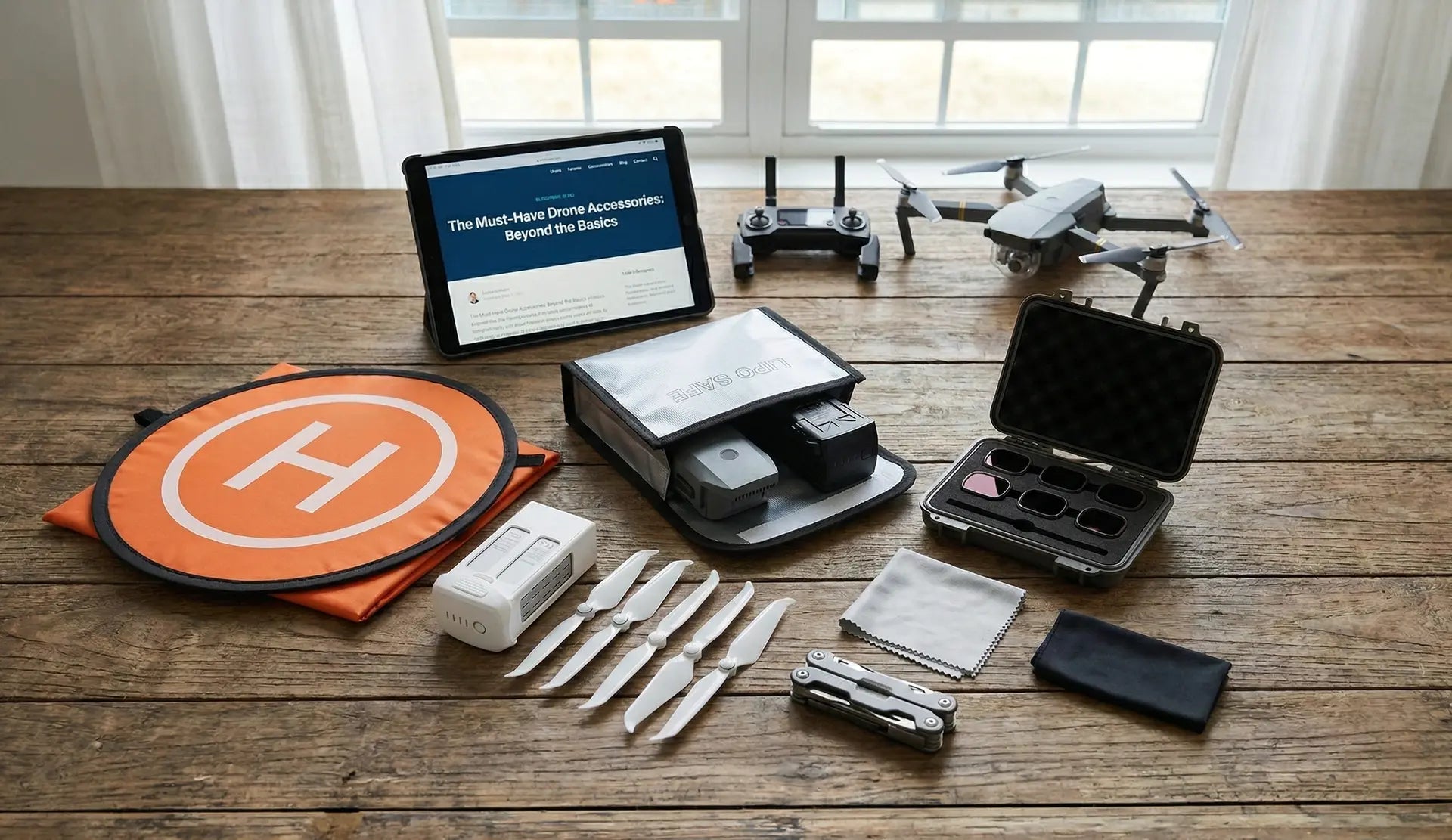
- ND (Neutral Density) Filters: Think of these as sunglasses for your drone. When shooting video, you generally want your shutter speed to be double your frame rate (the 180-degree shutter rule) to achieve natural motion blur. In bright sunlight, this is impossible without overexposing the image. An ND filter cuts the amount of light entering the lens, allowing you to keep that cinematic shutter speed even at noon.
- CPL (Circular Polarizer) Filters: Have you ever tried to film a lake or the ocean, only to see a giant white reflection of the sun on the surface? A CPL filter cuts through that glare, allowing you to see into the water and deepening the blue of the sky. These are essential for coastal photography and real estate shoots involving windows.
Pro Tip: Not sure which strength to use? Check out our multi-pack filter kits tailored for your specific drone model to cover every lighting condition.
Category 2: Protection and Transport
Your drone is a precision instrument. Treating it like one extends its lifespan significantly.
- Landing Pads: The gimbal is the most fragile part of your drone, and it sits very close to the ground. A weighted landing pad provides a clean, flat surface, protecting your camera and motors from tall grass, sand, and dust during takeoff and landing.
- Propeller Guards: If you are flying indoors or maneuvering through tight tree lines, these are non-negotiable. They protect your props from walls and, more importantly, protect people and objects from your spinning props.
- Hard-Shell Carrying Cases: Soft bags are great for hiking, but for serious travel, you need a hard-shell case. These offer impact resistance and moisture protection, ensuring your investment arrives at the shoot location in one piece.
Category 3: The Power Ecosystem
Nothing kills the vibe of a flight session faster than a dead battery. A robust power ecosystem is the core of a productive day.
- Multi-Battery Charging Hubs: Stop waking up every hour to swap batteries on the charger. A hub allows you to plug in 3 or 4 batteries at once. It will charge them in sequence (from highest charge to lowest), giving you a fully charged battery as fast as possible. It is a "set it and forget it" solution.
- Car Chargers: For the pilot on the move, a car charger is crucial. It allows you to cycle your batteries while driving between locations on a road trip.
- Portable Power Stations: Want an "infinite" field day? Pairing your charging hub with a portable power station (especially one compatible with our solar kits) allows you to recharge your batteries anywhere, completely off the grid.
Category 4: Data and Maintenance
You’ve captured the perfect shot—make sure you can actually save it.
- High-Speed MicroSD Cards: Not all cards are created equal. For 4K or 5.1K video, you need write speeds that can keep up. Look for "Class 10" and "V30" (or V60/V90) ratings. A slow card results in dropped frames or corrupted files.
- Lens Cleaning Kits: Drones fly through dust, pollen, and bugs. Because drone sensors are small, even a tiny smudge can ruin a whole day’s worth of footage. Keep a microfiber cloth and lens pen in your bag at all times.
- Signal Boosters/Range Extenders: If you frequently fly in urban areas with high WiFi interference or dense forests, parabolic signal boosters can help direct your controller's signal more effectively toward the aircraft.
Category 5: Safety and Compliance
Flying safely isn't just about following the law; it's about peace of mind.
- Anti-Collision Lights (Strobes): In many regions, flying during "civil twilight" (30 minutes before sunrise or after sunset) requires anti-collision lighting visible for 3 statute miles. A dedicated strobe ensures you are legal and visible to other aircraft.
- Fire-Proof LiPo Bags: Lithium-Polymer (LiPo) batteries are powerful but volatile if damaged. A fire-proof bag is a vital safety accessory for storing your batteries at home and transporting them on planes.
Conclusion: Build Your Ultimate Kit
You don’t need to buy every single item on this list today. Start with the essentials—perhaps a landing pad and a good MicroSD card—and build your kit as your skills grow. However, adding these tools to your arsenal will inevitably make your workflow smoother and your footage more professional.
Ready to upgrade?
Browse our curated selection of drone accessories and find the perfect gift for yourself (or the pilot in your life) today!