

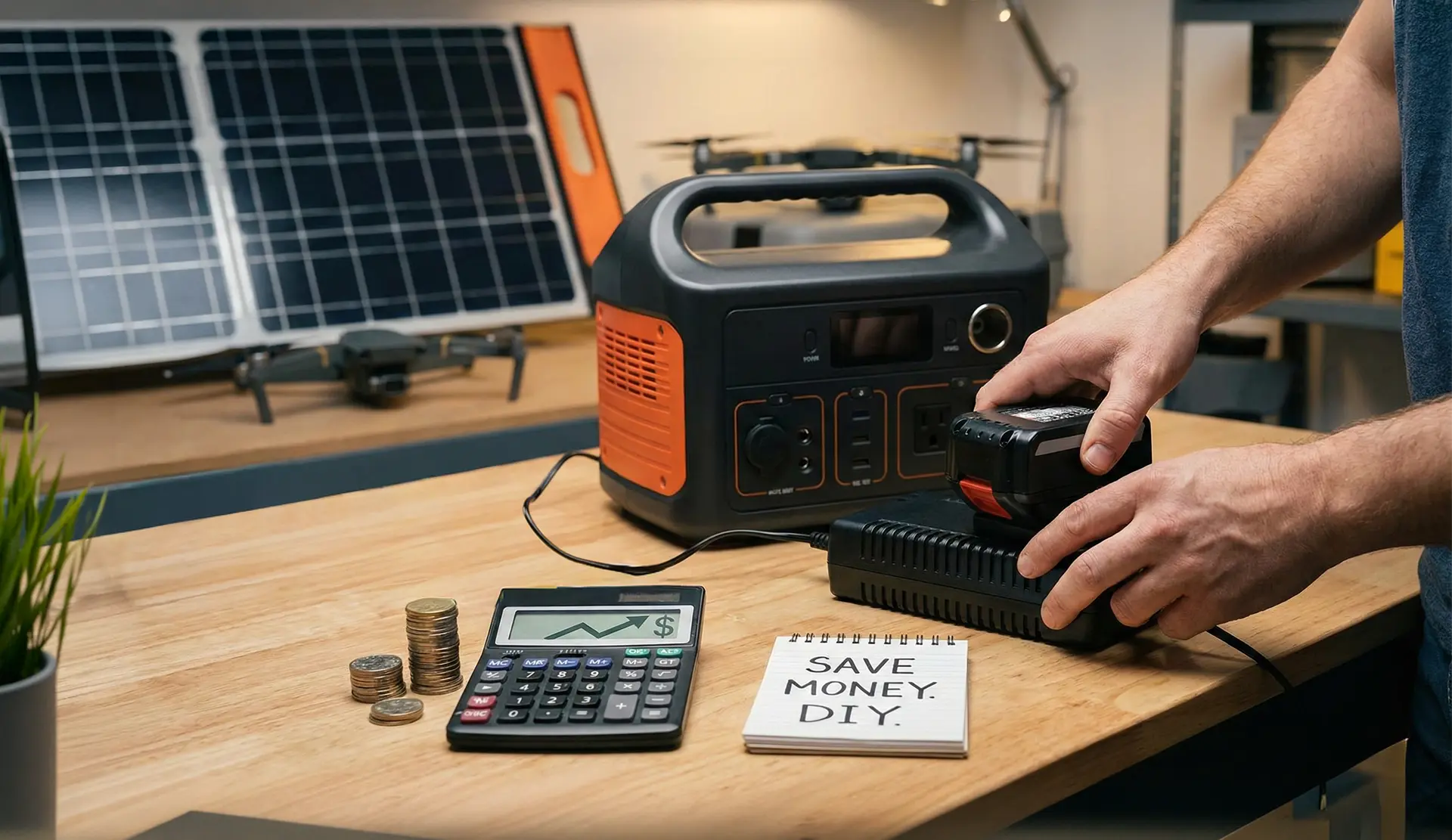


When most people look at a high-capacity solar kit or a replacement power tool battery, they see one thing: an expense. They see money leaving their bank account.
But smart equipment owners see something different. They see a way to "pre-pay" for years of energy and productivity at a massive discount.
Whether you are debating a solar setup for your RV or wondering if you should toss that old drill, the numbers usually tell a surprising story. This guide breaks down the actual math of how generating your own power and reviving old tools isn't a cost—it’s an investment strategy.
Part 1: The Solar Kit ROI (The Big Picture)
Solar is often the biggest upfront purchase, but it also offers the clearest math for Return on Investment (ROI). To understand if solar is worth it, you need to look beyond the sticker price.
The Basic Formula
To figure out when your system becomes "free," use this simple payback calculation:
(Total System Cost - Tax Incentives) ÷ Annual Utility/Fuel Savings = Payback Period (in years)
Once you pass the payback period, every kilowatt-hour (kWh) you generate is essentially free money.
The "Hidden" Savings
The formula above is conservative. It doesn't account for two massive factors that accelerate your savings:
- Avoiding Tiered Pricing: Utility companies often charge higher rates during "peak" usage times (late afternoon/evening). Solar allows you to use your own stored power during these expensive windows, keeping you out of the highest rate brackets.
- The Inflation Hedge: Utility rates rise by an average of 3-5% annually. Buying a solar kit today effectively "locks in" your electricity rate for the next 20+ years. While your neighbors' bills go up every year, yours stays flat.
Real-World Scenario: The Off-Grid Cabin
Imagine you have a small off-grid cabin.
- The Old Way: You run a gas generator. Between fuel costs, oil changes, and maintenance, you spend roughly $400 per season to keep the lights on.
- The Solar Way: You buy a solar kit for $800.
The Math: In just two years, the solar kit has paid for itself. By year three, you are pocketing that $400 every season. Plus, you no longer have to listen to a noisy engine while trying to enjoy nature.
Part 2: The Power Tool Battery ROI (The Practical Save)
We have all been there: Your trusty drill starts dying after five minutes of use. The temptation to just buy a brand-new kit is strong, but financially, it’s usually the wrong move.
The Math of "Revival"
Let’s look at the price difference:
- Cost of a new professional-grade Drill Kit: $200+
- Cost of a high-capacity replacement battery: $45 - $60
The Logic: If the motor in your tool is still good, buying a whole new kit just because the battery died is like buying a new car because the gas tank is empty.
Productivity is Profit
ROI isn't just about what you spend; it's about what you get done. Modern replacement batteries often feature higher Amp-hour (Ah) ratings than the stock batteries that came with the tool five years ago.
- Higher Ah = Longer Run Time.
- Longer Run Time = Fewer trips to the charger.
By reviving the tool with a better battery, you aren't just saving $150; you are completing projects faster.
Part 3: The Drone Battery ROI (The "Cost per Flight")
For drone pilots, batteries are the lifeline of the hobby (or profession). When calculating ROI here, you need to think in terms of Cost Per Flight.
The Flight Calculation
A healthy, high-quality battery provides roughly 25 minutes of flight time. A degraded or cheap battery might struggle to hit 10 minutes.
The Trap of "Cheap" Batteries
You might find an unbranded, knock-off battery that saves you $20 upfront. However, these often use inferior cells that degrade after only 30 cycles. A premium battery is built to last 200+ cycles.
The Comparison:
- Cheap Battery: $50 cost ÷ 30 flights = $1.66 per flight.
- Premium Battery: $80 cost ÷ 200 flights = $0.40 per flight.
The "expensive" battery is actually 4x cheaper to own in the long run.
Maximizing Your ROI (Maintenance is Money)
The math above relies on one crucial factor: Longevity. The longer your equipment lasts, the better your ROI becomes.
- Follow the Guide: Proper charging habits and storage temperatures (as detailed in our Maintenance Guide) are what ensure your battery hits that 200-cycle mark rather than failing at 50.
- Efficiency Matters: For drone pilots, using accessories like ND Filters helps you capture the shot correctly the first time. Fewer re-shoots mean less flight time wasted, fewer battery cycles used, and a longer lifespan for your gear.
Conclusion: The "Long Game" Wins
Whether it is generating electricity for $0.15 per kWh from the sun or saving $150 by reviving a perfectly good drill, the math heavily favors the high-quality DIY approach. It requires a shift in mindset from "spending money" to "securing future savings," but your bank account will thank you in the long run.
Start your savings journey today.
Browse our replacement batteries to give your favorite tools a second life!