

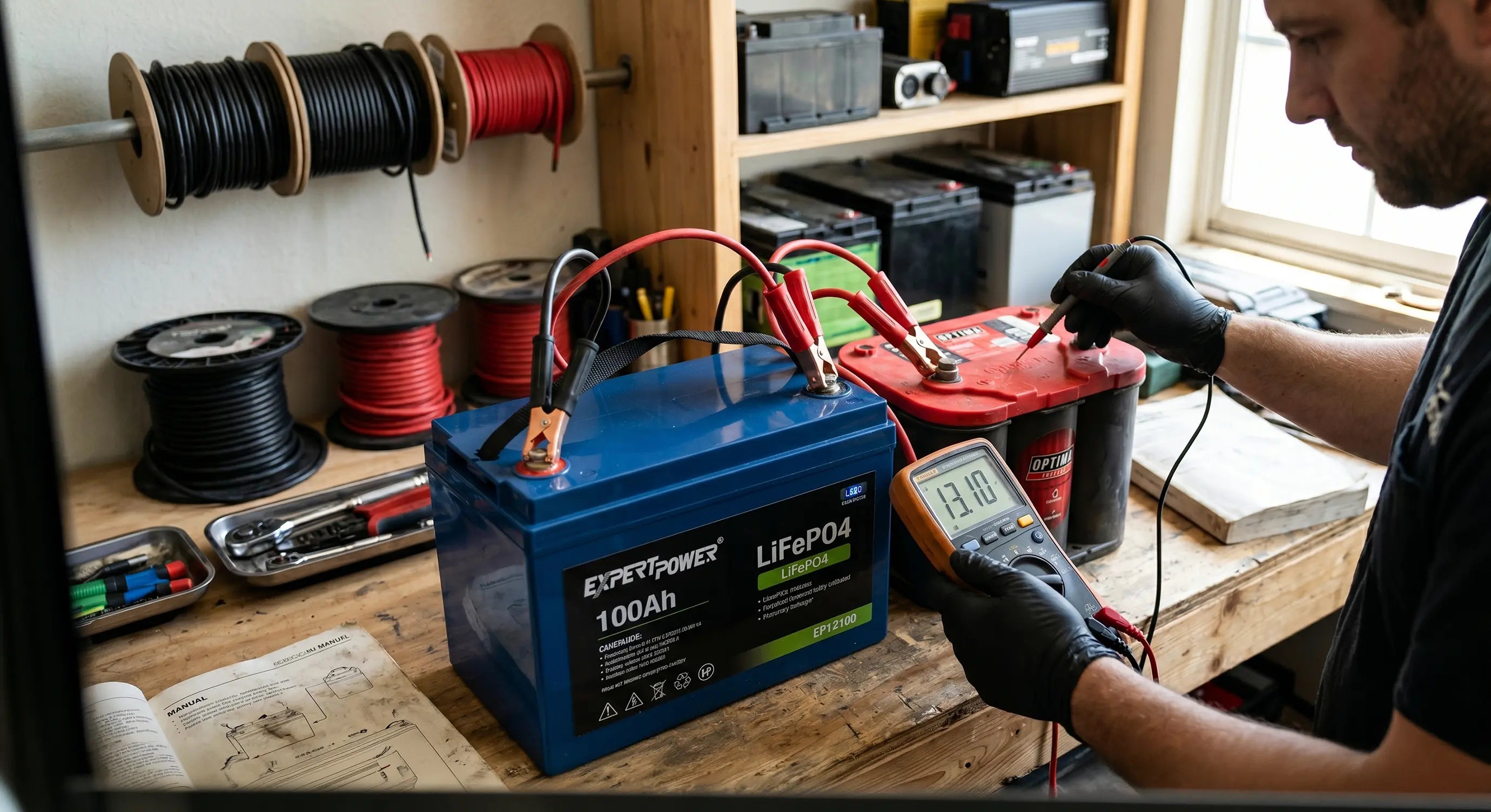


Picture this: You’re off-grid in your RV, deep into a marine fishing trip, or running your custom solar setup, and suddenly everything goes dark. You pull out a multimeter, touch the leads to your battery terminals, and it reads exactly 0.0 Volts.
To anyone raised on traditional lead-acid or older Sealed Lead Acid Batteries, a 0V reading signifies a catastrophic, fatal battery failure. You might instantly panic, thinking your significant investment is completely ruined.
But if you are running modern lithium technology, we have great news: Your battery isn't dead. It’s just sleeping. In fact, it did exactly what it was engineered to do to protect itself. This phenomenon is known as a BMS "trip," and understanding how it works—and how to reverse it—will change how you manage your off-grid power.
The Invisible Bodyguard: What is a BMS?
Unlike old-school battery chemistries that will willingly degrade, melt, or permanently damage themselves if abused, modern 12V LiFePO4 Batteries feature a highly advanced internal brain called a Battery Management System (BMS).
The BMS acts as a non-stop, microscopic electronic bodyguard. It continuously samples and monitors individual cell voltages, ambient temperatures, and the incoming or outgoing current flow. If any of these metrics cross a dangerous safety threshold, the BMS instantly opens its internal solid-state switches (known as MOSFETs). This breaks the circuit, isolating the lithium cells from the external terminals and causing your voltmeter to show a temporary 0V reading. This is a deliberate protection mechanism.
The Top 4 Triggers: Why Did My BMS Trip?
A smart system rarely acts without reason. If your battery has cut power, it is almost always due to one of these four fundamental safety boundaries being crossed:
1. Over-Discharge Protection (Low-Voltage Cutoff)
This is the most common real-world trigger. If you leave an appliance running or have a hidden "parasitic load" draining your system over a long period, the individual lithium cells will drop to their minimum safe threshold (typically around 2.0V to 2.5V per cell, or roughly 10V overall for a 12V block). To stop the cells from draining to absolute zero—which permanently ruins their chemical structure—the BMS shuts the door, storing a tiny safety reserve inside that it hides from the outside world.
2. Over-Current Protection (The Heavy Load Trap)
Every lithium battery has a maximum continuous discharge rating (for example, 100 Amps). If you attempt to power a massive 2,000W inverter or a heavy inductive load (like a microwave, compressor, or power tool) off a single battery that isn't sized for it, the massive current spike forces an instantaneous shutdown. The BMS trips in a matter of milliseconds to prevent internal busbars and copper wiring from overheating.
3. Short-Circuit Protection
If a metal wrench accidentally slips and bridges your positive and negative terminals, an almost infinite amount of current attempts to rush through the system. Long before a dangerous thermal event can escalate, the ultra-fast short-circuit logic of our premium Integrated Battery Management systems severs the connection, saving your equipment and your battery.
4. Low-Temperature / High-Temperature Safety Cutoffs
Lithium Iron Phosphate is incredibly resilient, but it obeys strict chemical laws. Forcing a high-current charge into a lithium cell when internal temperatures drop below freezing (32°F / 0°C) causes an effect called "lithium plating." This creates structural defects on the cell anodes that permanently degrade capacity and increase internal short risks. A high-quality BMS acts as a firm hard-stop, refusing charge current until conditions return to a safe operating envelope.
The Catch-22 of a Tripped Battery
When the BMS opens its switches to protect the battery, standard "smart" automotive chargers or vehicle alternators can no longer detect any voltage at the terminals. Because they see 0V, these external chargers assume no battery is connected at all and refuse to send power—trapping your battery in an unresponsive state.
The Recovery Protocol: How to "Wake Up" a Tripped BMS
If you find yourself with an unresponsive battery, don't worry. Follow these step-by-step procedures to wake your system up safely:
- Isolate and Remove the Load: Completely disconnect the battery cables from your inverter, fuse blocks, or charge controllers. If a short-circuit or an excessive load is still physically connected to the terminals, the BMS will instantly re-trip the microsecond you try to reset it.
- Use a Lithium Charger with 0V Wake-Up Functionality: Modern chargers designed specifically for LiFePO4 batteries feature a specialized "BMS Reset," "Force," or "Wake-Up" mode. When activated, the charger forces a small, low-current voltage pulse down the line. This tiny signal tells the internal BMS: "A safe charging source is present; it is safe to close the switches." Once the BMS clicks shut, normal charging resumes automatically.
- The Parallel Jump Start Trick (Field Recovery): If you are stranded off-grid without a specialized lithium charger, you can use a secondary power source to trigger the wake-up logic. Hook up your tripped lithium battery in parallel (positive to positive, negative to negative) to a fully functional 12V lead-acid battery, a portable jump pack, or another active lithium battery for just 5 to 10 seconds. The ambient voltage from the secondary source tricks the tripped BMS into closing its circuit. Disconnect the donor battery immediately and let your primary charging source take over.
Proactive System Sizing: Prevent the Trip Before It Happens
While recovering a tripped battery is simple, preventing the trip altogether makes for a much smoother off-grid experience. Keep these professional system-design tips in mind:
- Size Your Battery Bank to Your Inverter: Ensure your total continuous current capabilities match or exceed your inverter's maximum draw. If you have a high-wattage inverter, connect multiple batteries in parallel to share the current load safely across multiple BMS units.
- Program Your Charge Controller's LVD: Don't force your battery's internal BMS to do the dirty work of cutting off loads. Program your external solar charge controllers or battery monitors with a Low Voltage Disconnect (LVD) threshold of roughly 11.5V. This cuts power to non-essential loads gracefully before the battery drops low enough to force a hard emergency BMS shutdown.
By understanding that your BMS is a precision safety tool designed for asset protection rather than a point of failure, you can confidently build, monitor, and troubleshoot your off-grid power systems with complete peace of mind.