

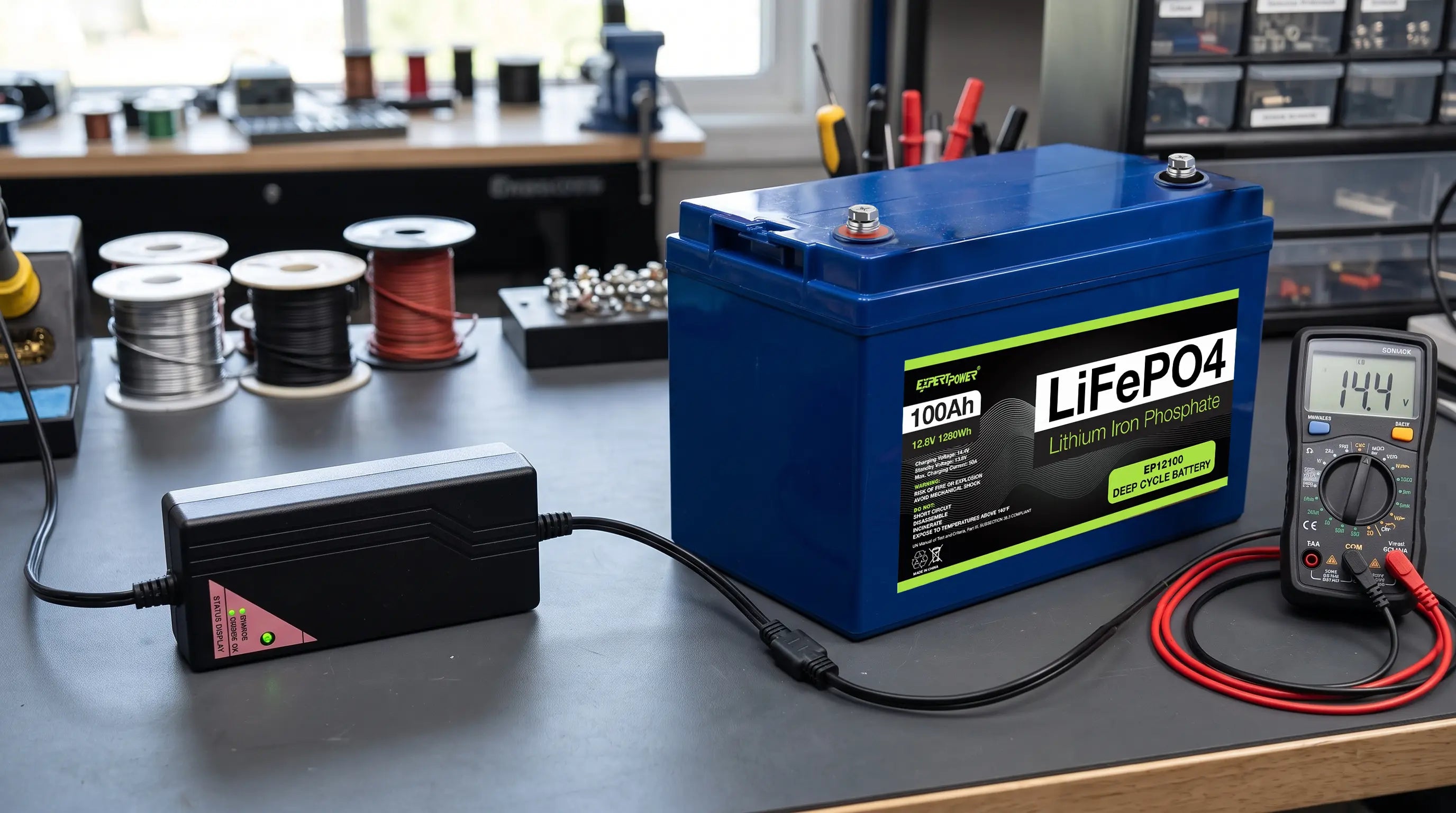


After upgrading to a high-performance lithium battery, it is tempting to reach for your existing garage charger. The logic seems straightforward enough: both batteries are rated for 12 volts, both feature positive and negative terminal posts, and both power the same inverters, trolling motors, or RV appliances. So why invest in a dedicated lithium charger?
While an old automotive or marine lead-acid charger might push current into a lithium battery in a pinch, doing so on a regular basis creates severe algorithmic conflicts. Lithium Iron Phosphate (LiFePO4) chemistry requires a fundamentally different charging method than traditional flooded, AGM, or sealed lead-acid (SLA) batteries. Using the wrong algorithm risks tripping your internal protection systems, causing chronic undercharging, and cutting your battery's service life short.
The Algorithmic Clash: Multi-Stage Lead-Acid vs. 2-Stage CC/CV
To understand the mismatch, look at how each charger talks to battery chemistry.
How Lead-Acid Chargers Work
Lead-acid batteries suffer from heavy natural self-discharge, acid stratification, and internal plate sulfation. To combat this, standard lead-acid chargers use complex 3-stage or 4-stage cycles:
- Equalization / Desulfation: A deliberate over-voltage burst (often exceeding 15.5V to 16V+) designed to shake up stratified liquid acid and dissolve hardened lead-sulfate crystals from lead plates.
- Continuous Float Stage: After absorption, the charger continuously trickles 13.5V to 13.8V into the battery indefinitely to offset the high self-discharge rate typical of lead plates.
How LiFePO4 Chargers Work
LiFePO4 chemistry contains no liquid acid to stratify and does not generate sulfate crystals. Instead, it requires a clean, controlled two-stage Constant Current / Constant Voltage (CC/CV) charge profile:
- Constant Current (Bulk Stage): The charger supplies its full rated amperage while battery voltage steadily rises up to the target ceiling (~14.4V–14.6V for a standard 12V 4-cell pack).
- Constant Voltage (Absorption Stage): The charger holds the target voltage steady while current naturally tapers down toward near-zero as the cells saturate.
- Full Termination (No Trickle): Once saturated, the charger stops active charging. Because LiFePO4 has a negligible self-discharge rate (only ~2% to 3% per month), it does not need or tolerate continuous float voltage, which slowly degrades internal cell materials over prolonged storage.
What Actually Happens When You Use a Lead-Acid Charger
1. The BMS Over-Voltage Disconnect (0V Reading)
If your legacy charger initiates an automatic desulfation cycle or high-voltage equalization pulse (>15.0V), the internal Integrated Battery Management system steps in. To prevent the individual cells from being overcharged, the BMS opens its internal charge MOSFETs, cutting off the circuit. The battery terminals immediately read 0V, causing many owners to mistakenly believe their new battery just failed.
2. The "90% Trap" (Premature Float and Undercharging)
A standard 12V lead-acid battery is considered fully charged at roughly 12.7V. A 12V LiFePO4 battery, on the other hand, rests around 13.3V to 13.4V and requires an absorption voltage of 14.4V–14.6V to achieve true 100% capacity. When an older lead charger detects the battery passing 13.6V, it often assumes the battery is near completion and transitions prematurely into low-voltage float mode. The result? Your lithium battery remains stuck between 70% and 85% capacity, robbing you of the full runtime you paid for.
3. Chronic Cell Imbalance
Passive cell balancing inside a lithium battery occurs almost exclusively during the final absorption window, when the highest-voltage cells exceed 3.45V per cell (above ~14.0V on a 12V pack). If a lead-acid charger drops into float early, the BMS never enters its balancing window. Over several dozen cycles, slight variations between individual cells compound, reducing the overall usable capacity of the entire pack.
The 0V Wake-Up Dilemma
If your battery ever completely drains, or if an accidental short circuit or over-voltage pulse causes the BMS to trip into protection mode, the battery outputs zero terminal voltage. Standard automotive smart chargers require reading residual voltage (usually 2V to 8V) before they initiate current flow. Because the tripped lithium pack shows 0V, the charger assumes no battery is connected and refuses to activate.
Dedicated ExpertPower LiFePO4 Chargers feature built-in 0V activation circuitry. They supply a steady, low-voltage wake-up signal to signal the BMS, closing the internal protection switches safely and allowing normal charging to resume automatically.
Selecting the Right LiFePO4 Charger for Your Bank
Matching your charger's output current to your battery's amp-hour (Ah) rating ensures optimal cycle life and efficient charge times. A standard rule of thumb is a charge rate between 0.2C and 0.5C (20A to 50A per 100Ah of capacity):
- Portable Electronics & Sonar Packs (7Ah–20Ah): The EPC121 (12V 1A) or EPC122 (12V 2A) provides gentle, controlled replenishment for kayak fishfinders, deer feeders, and compact gear.
- Mid-Range Deep-Cycle Packs (20Ah–50Ah): The EPC125 (12V 5A) delivers reliable overnight turnaround for small trolling setups and mobility applications[cite: 5].
- Standard Drop-In Banks (100Ah–200Ah): The EPC1220 (12V 20A) sits right at the optimal 0.2C rate for single 100Ah batteries, providing a complete 0-to-100% recharge in approximately 5 hours without generating excess heat[cite: 5].
- High-Capacity & Commercial House Banks (200Ah–400Ah+): The EPC1250 (12V 50A) provides rapid turnaround for heavy RV setups, off-grid cabins, and mobile work trucks running parallel battery banks[cite: 5].
Protect Your Battery Investment with Dedicated Charging
Ensure fast, balanced charging and full capacity on every cycle. Pair your lithium setup with chargers engineered specifically for LiFePO4 chemistry.
Explore ExpertPower LiFePO4 Chargers