

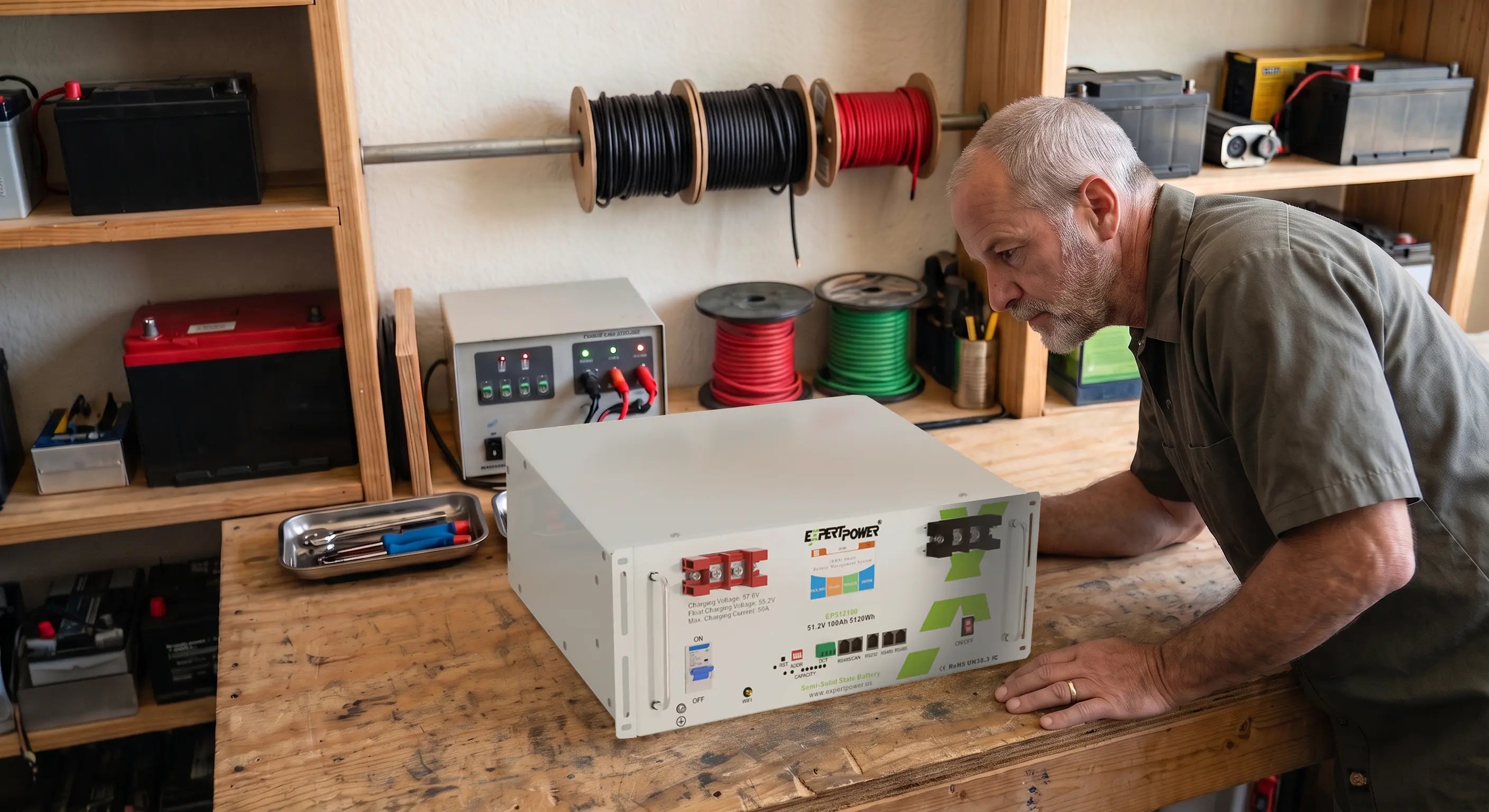


When shopping for LiFePO4 (Lithium Iron Phosphate) batteries, you are almost always confronted with a dazzling number: "Lasts 10 Times Longer Than Lead-Acid!" or "5,000+ Deep Cycles!"
This "5,000 cycles" metric—known as Cycle Life—is the industry gold standard for performance. It’s an easy, impressive number. But it’s only half the story. The chemical reality is that your battery has *two* life expectancies, and the second one, Calendar Aging, may be far more critical to your investment.
To guarantee your LiFePO4 battery hits that coveted 10-year mark, you have to move beyond the marketing pitch and understand the technical and chemical reality of how these cells actually degrade.
The Dual Lifespans of LiFePO4
A lithium battery is a dynamic chemical reactor. It is always degrading, but it does so in two distinct ways:
- Cycle Life (Active Aging): This is the degradation that occurs when you physically charge and discharge the battery. Every time lithium ions travel between the cathode (positive) and the anode (negative), they wear down the physical structure of the cell. Think of this as the *mileage on your car.*
- Calendar Aging (Passive Aging): This is the degradation that occurs *regardless* of whether you use the battery or not. As soon as a lithium cell is manufactured, a clock starts ticking. Chemical reactions inside the cell proceed slowly over time, consuming the lithium ions and electrolyte that the battery needs to function. Think of this as the *age of the car’s engine—even if it’s been parked in a garage for years.*
The definitive guide to your battery’s lifespan requires balancing these two factors. In most real-world applications (RVs, seasonal cabins, and marine deep-cycle use), Calendar Aging is the dominant factor that will determine the battery's ultimate life.
The Chemistry of Degradation: Meet the SEI Layer
To understand why a parked lithium battery still ages, you have to look microscopic.
Inside every new LiFePO4 cell, a critical chemical structure forms on the anode during its very first charge: the Solid Electrolyte Interphase (SEI) Layer. This nanometer-thin passivating layer acts as a protective shield. It allows lithium ions to pass through while preventing the raw carbon anode from reacting with the volatile liquid electrolyte.
The health of the SEI layer dictates the health of the battery.
Cycle degradation (active): Each deep discharge cycle (going from 100% to 0%) causes the anode particle to slightly expand and contract. This microscopic physical movement can crack and rupture the SEI layer. The BMS then has to use up fresh, active lithium and electrolyte to "repair" the crack, permanently reducing the battery’s capacity. Over thousands of cycles, this structure slowly disintegrates.
Calendar degradation (passive): The SEI layer is not a perfect shield. It is slightly permeable. Even when the battery is idle, electrolyte molecules slowly seep through and react, causing the SEI layer to grow thicker over time. This thickening acts like plaque in an artery: it consumes precious active lithium, reduces the surface area available for current flow, and drastically increases the battery's internal resistance. This increase in resistance is why aged batteries can’t hold a stable voltage under load.
The Key to Calendar Longevity: Storage State of Charge (SoC)
This is the single most misunderstood concept in lithium battery management. While you might be tempted to "top off" your battery to 100% before parking it for the season, storing a LiFePO4 battery at 100% SoC is the worst thing you can do for its calendar life.
Storing at 100% SoC: High Voltage Accelerates Degradation
Storing a LiFePO4 cell at 100% SoC puts it into a high-voltage, high-stress chemical environment (typically ~3.60V to 3.65V per cell, or 14.4V+ for the pack).
At this high potential, the rate of passive chemical degradation increases exponentially.
- Accelerated SEI Thickening: The high voltage pushes more electrolyte particles through the protective SEI shield, causing it to thicken rapidly, locking up lithium ions and increasing resistance.
- Electrolyte Oxidation: The liquid electrolyte itself begins to oxidize and break down faster at high voltages, creating side products that foul the internal battery chemistry.
Chemically, a fully charged cell is like a tightly compressed spring—it desperately wants to return to a lower energy state.
Storing at 0% SoC: The Low Voltage Cutoff Trap
Storing at 0% is equally dangerous, but for a different reason. While chemical stress is very low, the problem is Parasitic Load.
Every LiFePO4 battery has an internal brain—the BMS—that draws a minuscule amount of current even when the battery is idle. Over many months, this parasitic draw can pull the cell voltage below the critical emergency cutoff point (e.g., below 2.0V per cell).
Once a cell voltage drops this low, the copper busbars inside the cell can dissolve into the electrolyte. When you try to recharge the battery later, this dissolved copper precipitates back as dangerous microscopic "spikes" called dendrites, which can pierce the separator and cause a localized short circuit.
A cell that has "sat at 0V" for months is often chemically compromised and must be handled with extreme caution.
The Definitive Off-Season Storage Guide (The 10-Year Promise)
If you use your LiFePO4 battery aggressively and deeply discharge it every single day, you may achieve 5,000+ cycles in 6–8 years before the active material is exhausted.
But if you are a seasonal user, your goal is to manage Calendar Aging to ensure your battery reaches its mechanical potential. Follow this guide to hit that 10-year mark.
Step 1: Aim for 50% SoC (The Chemical Sweet Spot)
For long-term storage (months or seasons), you must target the chemical state that minimizes stress. The chemical sweet spot for LiFePO4 calendar aging is approximately 50% to 60% State of Charge.
This SoC offers the best compromise:
- The overall voltage potential is low (around 3.25V per cell, or 13.0V for a 12V pack), minimizing stress on the SEI layer and electrolyte oxidation.
- The chemistry is stable and relaxed.
*A battery stored at 50% will degrade chemically at a fraction of the rate of a battery stored at 100%.*
Step 2: Cool and Dry Storage Environment
A second crucial factor for chemical reaction speed is temperature. Just as food lasts longer in a refrigerator, a battery’s parasitic chemical reactions slow down significantly in cooler temperatures.
- Target Temperature: Store the battery in a cool, dry place, ideally between 5°C and 20°C (41°F and 68°F).
- The Freeze Factor: While it is okay to store a *sleeping* LiFePO4 battery below freezing, you must never attempt to charge it below 0°C (32°F). Charging in freezing temps causes immediate, catastrophic lithium plating. A smart BMS is designed to prevent this, but storing it in a warmer place avoids the risk entirely.
Step 3: Complete Isolation
You must treat parasitic load as a long-term threat. You cannot rely on a master switch inside an RV or cabin, as hidden safety sensors (CO detectors, propane monitors) often draw power.
- Physically Disconnect: For off-season storage, completely disconnect the battery cables from the terminals. This ensures 0.00 Amps of external load.
- Rely on the BMS: The BMS will still have a tiny parasitic load of its own.
Step 4: The 6-Month Maintenance Pulse
Even a perfectly stored, disconnected battery at 50% SoC must be maintained.
- Set a reminder for every six months.
-
Top-Off and Pulse: Connect the battery to a LiFePO4-specific charger and let it achieve 100% SoC. This does three critical things:
- It wakes up the BMS and verifies it is functional.
- It replenishes any internal self-discharge or BMS parasitic draw, preventing the battery from entering the 0V trap.
- It allows the BMS to properly Balance the Cells (balancing only occurs during the final phase of a charge to 14.4V+).
- Discharge Back to 50%: Once the charge and balance are complete, use a small load (like a 12V bulb or fan) to discharge the battery back down to 50% SoC before returning it to the cool storage location.
Conclusion
The active "cycle life" of 5,000+ cycles gets the headlines. But in almost all real-world applications, your battery’s fate is determined by the quieter, slow chemical process of Calendar Aging.
By understanding that storage State of Charge and temperature are the master controls for passive degradation, you can move past the 5-cycle count obsession. By managing the chemical stress on your battery when it is parked, you are guaranteed that your 10-year investment will be ready to perform when the off-season ends.